

As Kenyans once again take to the streets for nationwide demonstrations today, a critical message must resonate unequivocally within the ranks of the National Police Service and its command structure: your ultimate allegiance is to the Constitution of Kenya, not to any individual or “order from above.”
Command Responsibility is Not a Slogan, It’s the Law
Police officers, particularly those in positions of command, must internalize a fundamental principle of law: following unlawful orders is not a valid defense. The Constitution is your supreme commander, and its tenets supersede any directive that contradicts them.
The Doctrine of Command Responsibility
Both domestic and international law firmly embed the doctrine of command responsibility. This doctrine holds senior officers directly accountable for the unlawful actions of their subordinates if:
- They knew or reasonably ought to have known of the misconduct, and
- They failed to take action to prevent or punish it.
This means that to all Officers Commanding Stations (OCSs), County Commanders, and field officers: if your juniors engage in abuses today, and you stand by idly, you will face personal legal liability. The buck stops with you.
The Illegality of Arbitrary Arrests and Detentions
The High Court of Kenya has already provided a clear precedent regarding the unlawful arrest and detention of peaceful demonstrators.
Consider the landmark decision in:
- Mohamed Feisal & 19 others v Henry Kandie, Chief Inspector of Police, OCS, Ongata Rongai Police Station & 7 others; NPSC & Another (Interested Parties) [2018] KEHC 627 (KLR)
In this case, the court unequivocally declared that the arrest and detention of peaceful protestors without reasonable cause were unlawful, arbitrary, and a direct violation of their rights as enshrined in Articles 29 (Freedom and Security of the Person), 47 (Fair Administrative Action), and 49 (Rights of Arrested Persons) of the Constitution. Crucially, the defense of “orders from above” was rejected outright. The court held individual officers, including the OCS Rongai, personally liable for the abuses committed under their watch. This judgment sends a clear message: accountability extends to every officer on the ground and their immediate commanders.
Excessive Force: A Crime, Not a Strategy
The use of excessive force by law enforcement agencies has been consistently condemned by courts globally. There is a universal legal consensus that force must be proportionate and used only when absolutely necessary, and never as a tool for suppression or punishment.
Let’s look at how various jurisdictions have addressed this critical issue:
- United States:
- Tennessee v. Garner, 471 U.S. 1 (1985): This seminal case established that deadly force may only be used by police when there is a clear and immediate threat to life. The court famously stated, “It is not better that all felony suspects die than that they escape.” This means shooting at fleeing suspects, especially unarmed ones, is unconstitutional.
- Graham v. Connor, 490 U.S. 386 (1989): This ruling emphasized that the use of force must be “objectively reasonable” given the specific circumstances from the perspective of a reasonable officer on the scene, rather than with the 20/20 vision of hindsight. Officers are not empowered to act as judge, jury, and executioner on the streets.
- Canada:
- R v. Nasogaluak [2010] 1 SCR 206: This case highlighted that police misconduct, including brutality, can lead to serious legal consequences, potentially resulting in stays of proceedings or reduced sentences for those affected by such abuse. It underscores that abuse of authority is never excusable and impacts the integrity of the justice system itself.
- Hill v. Hamilton-Wentworth Police [2007] 3 SCR 129: This judgment affirmed that negligent investigations and abusive policing practices are actionable offenses, opening avenues for civil liability against police forces and individual officers. This means victims of police misconduct can sue for damages.
- South Africa:
- Ex Parte Minister of Safety and Security: In re S v Walters [2002] ZACC 6: This Constitutional Court ruling emphasized that the police use of force must be strictly regulated and always balanced against fundamental constitutional rights. It declared that excessive force cannot be tolerated in a democratic society that values human dignity and rights.
No Shield in Illegal Orders
Article 2(4) of the Constitution of Kenya is unequivocally clear: Any law, conduct, or order that is inconsistent with the Constitution is invalid.
This means that if a politician or a superior officer issues an instruction to “deal” with protestors harshly, or to “disrupt” peaceful gatherings through unconstitutional means, you are under no legal obligation to obey. In fact, you are under a paramount legal duty to defy that order. Your oath is to the Constitution, not to individuals attempting to subvert it.
A Final Word to Police Officers on the Ground
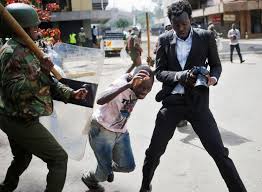
Today’s protests may bring heightened tension, and situations can be fluid. However, how you choose to respond will determine the difference between upholding justice and descending into chaos, between ensuring accountability and perpetuating impunity.
If you:
- Assault a protestor without cause,
- Fire upon unarmed youth,
- Arrest someone merely for peacefully holding a placard,
- Or allow your juniors to commit such acts under your command and supervision…
Be prepared to stand in the dock alone.
Because the doctrine of command responsibility is a formidable force, and it will find you.
And the Constitution?
It never sleeps.
Mokua Manyara- Adv
+254733491415